
When it comes to grow media, you would be hard-pressed to find a farmer or gardener uninterested in sustainability. Whether based on a regenerative agricultural philosophy to reduce climate chaos or simply economic viability to earn a living wage, most farmers and gardeners are interested in optimising any external input. Farmers are reducing their off-farm reliance by stretching their fertiliser budgets, saving seeds, and re-using soil or soilless media.

Western society’s increased dependence on controlled-environment agriculture as foundational for their food and medicinal systems has placed high demands on some relatively high-energy intensive inputs for making potting soils like peat moss, coco coir, and perlite. The “one and done” practice of growing your crop in a container filled with potting soil or nutrient-dense super soil (e.g., LSO – Living Soil Organics) and discarding the spent soil after harvest is becoming less popular and less economically viable than ever. Some cultivators will shred their spent soil and compost it, while others will re-purpose the soil and bag it up for community or school gardens.
Grow Media: Nature’s Lead
Increasingly, the notion of using living soil beds and reamending your beds either during the crop cycle or before the next crop planting has piqued the interest of growers who have traditionally used non-regenerative cultivation practices, such as Rockwool or coco drain to waste systems involving the heavy use of chemical fertilisers. Interests in creating “perpetual” indoor soil systems range from reduced labour (i.e., save time in transplanting; reduced pot-washing) to increases in plant health and enhanced nutrient cycling because of more robust microbial soil communities.
The concept of creating a living soil bed system to work in perpetuity by mimicking nature sounds simple. Still, the reality of creating a system with redundancies and balance is far more complex than it seems. While nature should always be the inspiration and ultimate authority on plant growth and bio-intelligence, it is imperative to remember that a controlled environment (i.e., indoor) agriculture is not natural.
Avoiding Disaster
The interconnection of the soil environment (i.e., temperature, pH, moisture) with nutrient amendments and soil microbiology requires a holistic approach because a change in any of these factors creates a cascade of changes in the living soil
ecosystem. The approach of throwing every ingredient in your soil that appeals to you can be disastrous. Excesses of nutrients can lead to ion exchange issues, making some elements unavailable for plant uptake, causing downstream effects like poor metabolite function, impeding quality, yield, etc.
In contrast, the goal of sufficiency, balance, and diversity is favoured over quantity in assuring the plant can feed itself as it requires. Concerning diversity, it is critical to provide all essential plant nutrients and a robust profile of trace minerals and diversify nutrient inputs regarding their availability.
For example, a nutrient like nitrogen (N) must be provided in fast-release forms like nitrate (e.g., hen manure, blood meal) as well as in slow-release forms (e.g., ammonium) like alfalfa meal, thereby ensuring nitrogen is being provided throughout the lifecycle of the plant.
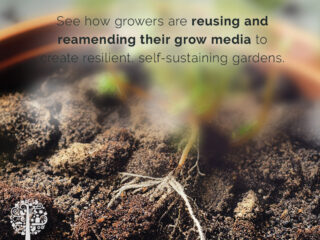
Grow Media: Boosting Productivity
How do you go about getting the most out of your growing media? Tissue tests, sap
analysis, and a soil biology test can be added tools to optimise your garden as you advance on honing your soil ecosystem, but a soil mineral test is necessary. Guessing that your soil needs more of this and a pinch of that is a surefire way to create soil imbalances.
Most soil labs will take 7 to 10 days to get results back, so it’s best to grab a sample about two weeks before crop harvest. Whatever lab you choose, it’s essential to stay
consistent, as each will have different extraction methods and testing techniques. While one soil test is a great start, the real benefit will come with building a data set over time. This is almost impossible if you don’t stick with the same lab. The same goes for your sampling techniques and ensuring you get the proper test for your media.
Representative sampling from all beds (to a depth of six inches) and requesting a saturated paste test and a soil carbon or compost/potting mix test is preferred over a natural field soil test. Despite the accuracy of the tests, it’s important to remember that they are a snapshot in time, and they can’t fully account for the eventual release
of nutrients as the previous crops’ root residues break down and microbes solubilise previously insoluble minerals. Therefore, the most critical rule of reamending living soil beds is “less is more.” It is much easier to address nutrient deficiencies than nutrient excesses and imbalances.
Let’s take a deeper look at the elements we are looking to replace:
Nitrogen (N)
Different crops and cultivars can have wide-ranging N requirements. Fast-release
nitrate forms can provide superior growth during vegetative growth, while slow-release
forms will provide an adequate nitrogen balance during the flowering or fruit fill period.
Over time, the goal of these living soil bed systems is to require fewer external inputs because of the increased benefit from nutrient cycling done by soil microbiology. However, until that time, the addition of N sources is required. Other than ensuring you are providing both fast and slow-release forms, growers should look to reduce N sources high in sodium (Na). The primary culprits include poultry manure, blood meal, and sea-based amendments like crab meal, fish bone meal, seaweeds, and kelp meal. Some cultivators rely more on higher carbon-based inputs like alfalfa meal or insect frass. Alternatively, higher-cost inputs like soybean meal, soy isolate, or amino acids can be Na-free while providing a significant N boost.
Phosphorus (P)
The greatest challenge with P is that it instantaneously reacts with seemingly everything, becoming immobilised in the soil and unavailable for immediate plant uptake. Adding bone meal, guano, and soft rock phosphate can increase levels on a soil test, but ensuring adequate populations of phosphorus-solubilising microbes is critical to plant availability. Living soil beds adopting a no-till or shallow-till approach can also benefit from the existing network of mycorrhizal networks (e.g., Rhizophagus irregularis aka Glomus intraradices) that help make P available.
Potassium (K) and Sulfur (S)
Certain crops like cannabis and grasses like slightly higher amounts of K, and all fruiting plants require extra K during flowering. Common forms of K inputs include Langbeinite (Sul-Po-Mag or K-Mag), Potassium Sulphate, Potassium silicate, and, to some extent, kelp meal.
Unfortunately for regulated cannabis growers who must test their flower for heavy metals, kelp can result in high arsenic (As) values. However, arsenosugars found in seaweeds are not toxic to humans like inorganic As, so kelp meal and kelp extracts must be used judiciously. While it can be an excellent biostimulant, most kelp products contain more sodium than potassium.
Similarly, over-reliance on sulphate sources can lead to excess sulphur. Sulphur is critical for N use efficiency and foundational for taste and aroma profiles in alliums, brassicas, and cannabis. Still, too much can lead to antagonistic relationships with other negatively charged ions like P.
Growers may look to alternative forms of S to avoid a buildup of sulfates. A cannabis grower with excessive sulfate levels in their living soil beds can use a cover crop of brassicas that will be harvested and destroyed to remove sulphur from the beds.
Calcium (Ca)
Most commercial living soil mixes do not contain adequate levels of available calcium. Many will target their pH to be slightly less than 6, and by the end of the season, the pH may increase to above 7 as Ca becomes more available. Ca can drive vegetative growth but remains essential in helping uptake many other nutrients, including trace minerals like Boron (B). Not only is calcium a building block for all cellular structures, but it is also an important signalling molecule in many metabolic reactions.
Excesses or imbalances in Ca can lead to deficiencies in other positively charged ions, including potassium and magnesium (Mg). The use of calcitic limestone can be a long-term solution for organic growers. In contrast, oyster shell flour (careful of excessive Na) or Wollastonite (calcium silicate) can be used if your pH needs to be increased, or gypsum (aka calcium sulfate) can be used if your pH is at the desired level. Often, a combination of various calcium inputs can be the best approach to ensure both soluble and long-term availability of this critical nutrient.

Magnesium (Mg)
Arguably, Mg deficiencies are some of the easiest to correct. In most plants, deficiencies are characterised by interveinal chlorosis (dark green veins and yellowing in between the veins).
The foliar (3% solution) or soil drench (5% solution) application of Epsom salts (aka magnesium sulfate) can rectify deficiencies within days. However, addressing the deficiency symptoms may not be getting to the cause. Mg deficiencies can be caused by excesses in K, Ca, or Na in the soil and can even be caused by an excess of Mg.
Getting to the root cause of deficiencies is why it is so critical to follow the less is more principle and why soil tests are an asset.
Micro Nutrients and Trace Minerals
Often wrongly considered less critical than macronutrients, micronutrients are essential for many metabolic processes. Growers will often rely on rock powders (glacial rock dust, volcanic or basalt rock, or Azomite) or sea minerals (kelp or sea salt) to
replenish levels, and it is encouraged to vary your sources and maintain the less is more philosophy. For those concerned about heavy metals, a certificate of analysis for these inputs is necessary, as many can be high in lead (Pb), Cadmium (Cd), As, and Na. For higher-end crops, rock powders and sea minerals may not deliver the necessary amounts of specific minerals like Iron (Fe), Copper (Cu), Cobalt (Co), Molybdenum (Mo), Zinc (Zn), Manganese (Mn). They may require sulfate-based foliar or soil applications.
One of the most neglected and misunderstood nutrients is Silicon (Si), which plays a critical role in a plant’s immune response, influencing pest and disease resistance and salt and drought stress. Applied via the soil or on a leaf, Si in plant-available forms can be great insurance for essential crops.
Finding organic sources may be difficult, so some growers rely on microbial activity to work on rock powders to achieve the desired results. In contrast, others may consider fermented horsetail (Equisetum arvense) an amendment.
Grow Media: Sufficiency, Sustainability, and Balance
As our food and medicine future evolves, we must create systems that rely less on external inputs and more on regenerative inputs and practices. Single-use growing media must become a thing of the past. Using an approach of sufficiency and balance in reamending living soil beds will be the future of controlled environment agriculture.
Trending Products

Ahopegarden Hydroponics Growing Sys...

Ahopegarden Hydroponics Growing Sys...

CYBSDF hydroponic-Growing-Kits-and-...

Hydroponics Growing System Kit 12Po...

Hydroponics Growing System Kit Indo...

BN-LINK 8 Outlet Surge Protector wi...

Light-Blocking Cube Caps Compatible...

SKINNYBUNNY Rockwool Cubes 1 inch, ...

Reusable Plant Support Clips for Ga...
